


PRICE
OVERVIEW, TERMS & CONTACT INFO
OVERVIEW
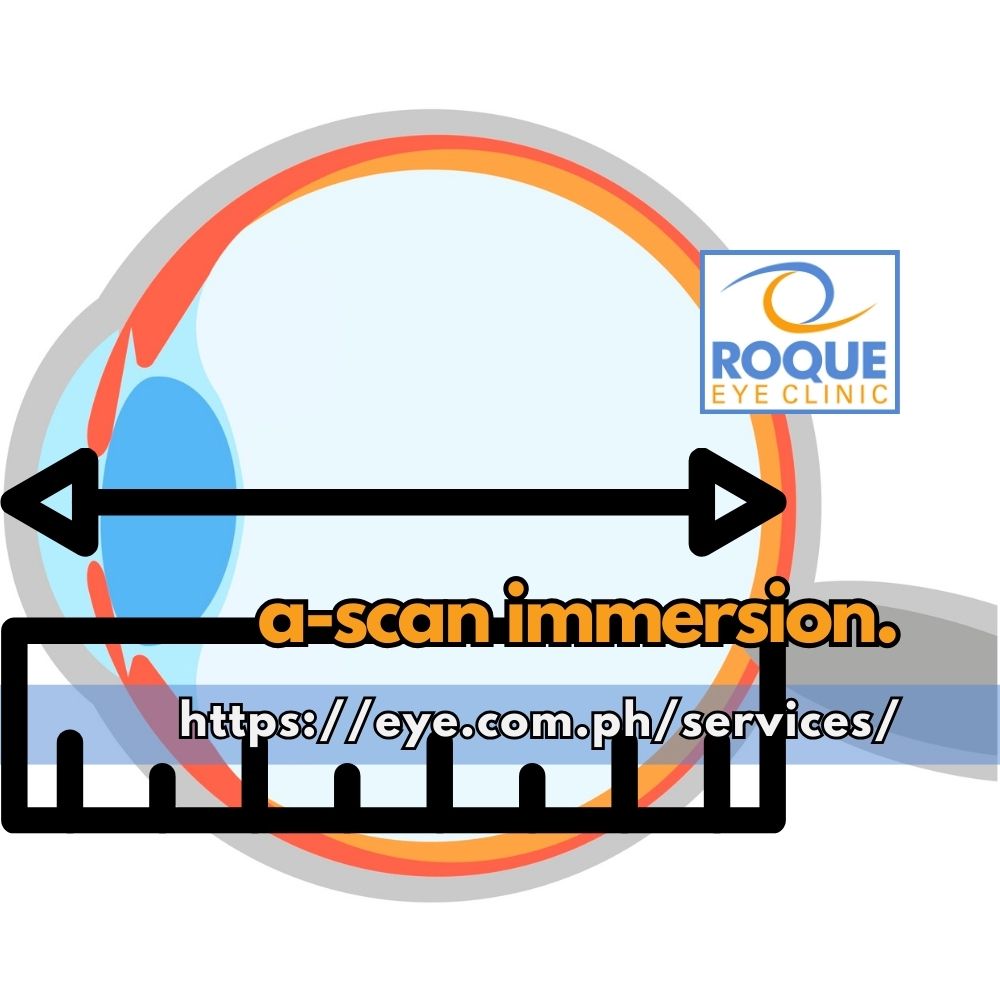
A-Scan Immersion is an ultrasound eye measurement test used before cataract and lens surgery to calculate the correct implant power. It uses a fluid interface instead of direct corneal contact, which improves accuracy. The test is quick, safe, and important for better surgical visual outcomes.
TERMS AND CONDITIONS, INCLUSIONS, AND EXCLUSIONS
1. Service includes immersion ultrasound axial length measurement only.
2. Lens power calculation requires physician interpretation and formula selection.
3. Fees may vary when bundled with other biometry tests.
4. Test supports surgical planning but does not guarantee refractive outcome.
5. Accuracy depends on cooperation and proper positioning.
6. Active eye infection may require test delay.
7. Additional diagnostics may still be required.
CONTACT INFORMATION
Dr. Manolette Roque | Dr. Barbara Roque
Asian Hospital and Medical Center
5th Floor, Unit 509, Roque Eye Clinic, Medical Office Building
2205 Civic Drive, Alabang, Muntinlupa City 1781, Philippines
+63-917-795-2020
+63-998-997-2020
+63-2-8771-9253
+63-2-8771-9000 ext. 7509
Dr. Manolette Roque | Dr. Barbara Roque
Asian Hospital and Medical Center
2nd Floor, Asian Eye Center, Medical Office Building
2205 Civic Drive, Alabang, Muntinlupa City 1781, Philippines
+63-939-915-6927
+63-2-8876-5776
+63-2-8771-9000 ext. 5776
+63-2-8771-9000 ext. 8204
DETAILS
A-SCAN IMMERSION
A-Scan Immersion is a precise ultrasound eye measurement service used to calculate the correct intraocular lens power before cataract or refractive lens surgery. It measures the true axial length of the eye using an immersion fluid interface instead of direct probe contact. As a result, it reduces corneal compression error and improves lens power accuracy.
WHAT THIS SERVICE DOES
This diagnostic ultrasound test measures the distance from the front of the cornea to the retina. That measurement directly supports intraocular lens computation. Therefore, surgeons rely on A-Scan Immersion when high accuracy is required. It is especially helpful when optical biometry is not suitable.
Because the probe does not press on the cornea, the measurement stays more stable. Consequently, the results often show better reproducibility than contact methods.
WHEN DOCTORS RECOMMEND A-SCAN IMMERSION
Your ophthalmologist may request this test in specific clinical situations where optical devices cannot obtain reliable readings.
1. Dense or mature cataracts
2. Media opacity that blocks optical scans
3. Poor fixation during optical biometry
4. Irregular corneas affecting optical accuracy
5. Lens calculation cross-checking
HOW THE PROCEDURE IS PERFORMED
The test uses topical anesthetic drops for comfort. First, a small immersion shell is placed gently between the eyelids. Next, sterile fluid fills the shell to create a coupling medium. Then, the ultrasound probe measures axial length through the fluid without touching the cornea. As a result, the scan avoids surface distortion and improves precision.
The procedure usually takes only a few minutes per eye. In most cases, patients tolerate it well.
PATIENT COMFORT AND SAFETY
A-Scan Immersion uses diagnostic ultrasound and topical anesthesia. Because the probe does not press on the eye, discomfort remains minimal. Sterile technique is used throughout the procedure. Moreover, complications are rare when performed by trained personnel.
WHY MEASUREMENT ACCURACY MATTERS
Accurate axial length measurement directly affects lens implant power selection. Even small errors can change the refractive outcome after surgery. Therefore, immersion technique supports better targeting of postoperative vision. In complex cases, it adds an important layer of measurement reliability.
Related Services
Related products
₱ 1,402.00
₱ 1,820.00
₱ 10,722.00
₱ 5,679.00


