

PRICE
OVERVIEW, TERMS & CONTACT INFO
OVERVIEW
Fluorescein Angiography with OCT Macula is a combined retinal test that evaluates blood flow and macular structure in one visit. It helps detect and monitor diabetic eye disease, macular degeneration, and retinal leakage. The service improves diagnostic accuracy and guides more precise treatment planning.
TERMS AND CONDITIONS, INCLUSIONS, AND EXCLUSIONS
1. Service includes fluorescein dye angiography and OCT macula imaging only.
2. Professional interpretation by the ophthalmologist is required.
3. Fees may vary based on case complexity and added diagnostics.
4. This service supports diagnosis but does not replace full examination.
5. Dye injection is required and may be deferred for medical contraindications.
6. Image quality depends on fixation and media clarity.
7. Additional tests may be recommended for complete evaluation.
CONTACT INFORMATION
Dr. Manolette Roque | Dr. Barbara Roque
St. Luke’s Medical Center – Global City
2nd Floor, Units 217-218, Roque Eye Clinic, Medical Arts Building
Rizal Drive cor. 5th Ave, Taguig City 1634, Philippines
+63-917-844-2020
+63-998-998-2020
+63-2-8828-2020
+63-2-8789-7700 ext. 7217
+63-2-8789-7700 ext. 7218
Dr. Manolette Roque | Dr. Barbara Roque
St. Luke’s Medical Center – Global City
2nd Floor, Tan Eng Gee Eye Institute, Main Hospital Building
Rizal Drive cor. 5th Ave, Taguig City 1634, Philippines
+63-998-582-1980
+63-2-8789-7700 ext. 2020
+63-2-8789-7700 ext. 2024
Dr. Manolette Roque | Dr. Barbara Roque
Asian Hospital and Medical Center
2nd Floor, Asian Eye Center, Medical Office Building
2205 Civic Drive, Alabang, Muntinlupa City 1781, Philippines
+63-939-915-6927
+63-2-8876-5776
+63-2-8771-9000 ext. 577
+63-2-8771-9000 ext. 8204
DETAILS
FLUORESCEIN ANGIOGRAPHY + OCT MACULA
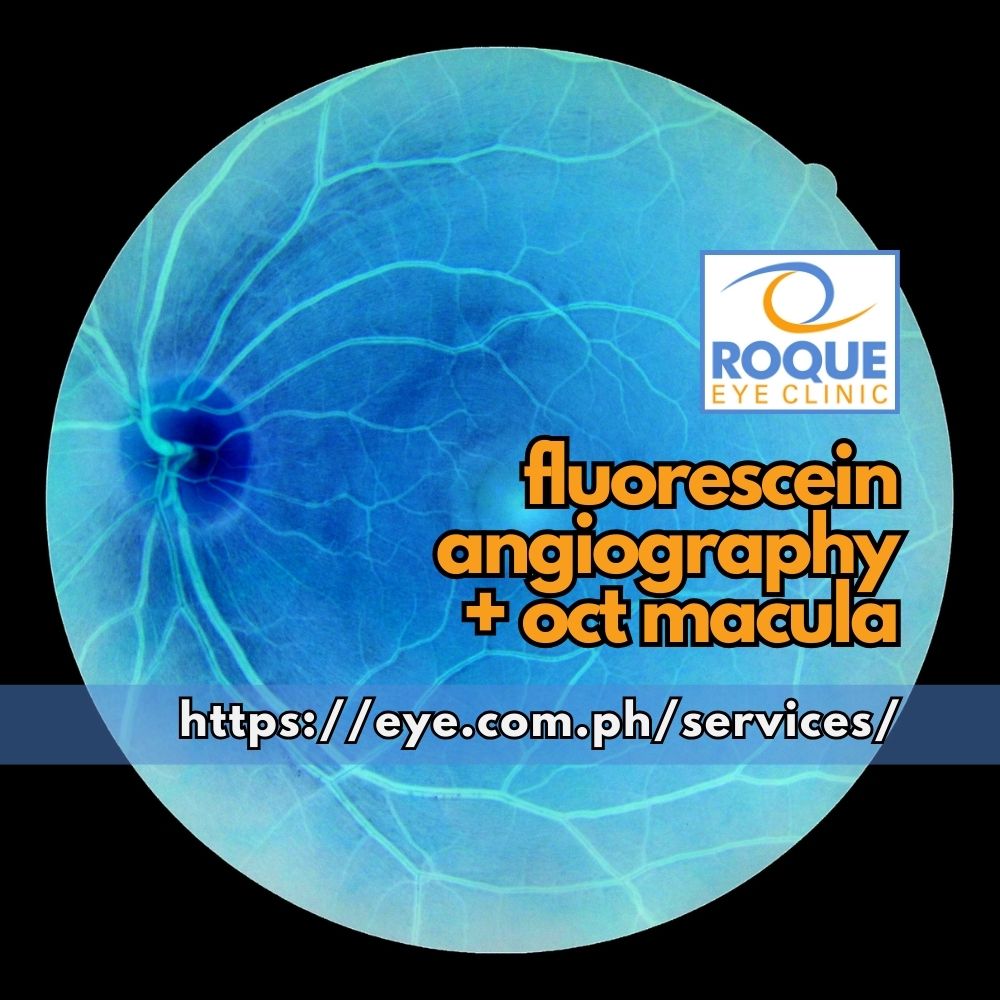
Fluorescein angiography combined with Optical Coherence Tomography (OCT) Macula is a comprehensive diagnostic eye imaging service that evaluates retinal structure and blood flow. This combined test allows your ophthalmologist to detect, document, and monitor diseases affecting the macula and retinal circulation. As a result, it supports accurate diagnosis and guides timely treatment planning.
WHAT THIS SERVICE EVALUATES
This diagnostic combination assesses both anatomy and circulation of the retina. OCT Macula provides high-resolution cross-sectional images of the retinal layers. Meanwhile, fluorescein angiography tracks blood flow using a special dye. Therefore, the test helps detect swelling, leakage, blockage, or abnormal vessel growth.
This service is commonly used for conditions such as diabetic retinopathy, macular edema, age-related macular degeneration, retinal vein occlusion, and other vascular retinal disorders.
HOW THE PROCEDURE IS PERFORMED
First, the healthcare team administers dilating eye drops to widen the pupils. Next, the technician performs OCT imaging to capture detailed retinal scans. Then, a trained professional injects fluorescein dye into a vein, usually in the arm. After that, a specialized camera captures a sequence of retinal images as the dye circulates. Consequently, your ophthalmologist analyzes both structural and vascular findings together.
WHO MAY BENEFIT
This diagnostic test supports patients who need detailed retinal evaluation. For example, it may be recommended for the following cases.
1. Patients with diabetes or suspected diabetic eye disease
2. Individuals with blurred or distorted central vision
3. Suspected macular degeneration or macular edema
4. Retinal vascular conditions or unexplained vision changes
5. Monitoring response to retinal treatments or injections
PATIENT SAFETY AND EXPERIENCE
Most patients tolerate the procedure well. OCT imaging is non-contact and painless. Fluorescein angiography involves a brief injection, and patients may notice temporary yellow discoloration of the skin or urine. However, these effects resolve naturally. The medical team monitors patients throughout the procedure to ensure safety.
CLINICAL VALUE
This combined approach improves diagnostic accuracy because it correlates structure with blood flow. Therefore, it helps your ophthalmologist decide on appropriate treatment, such as laser therapy, injections, or observation. Early detection and monitoring also improve long-term visual outcomes.
Related Services
Related products
₱ 24,436.00
₱ 10,722.00
₱ 11,082.00
₱ 5,293.00


